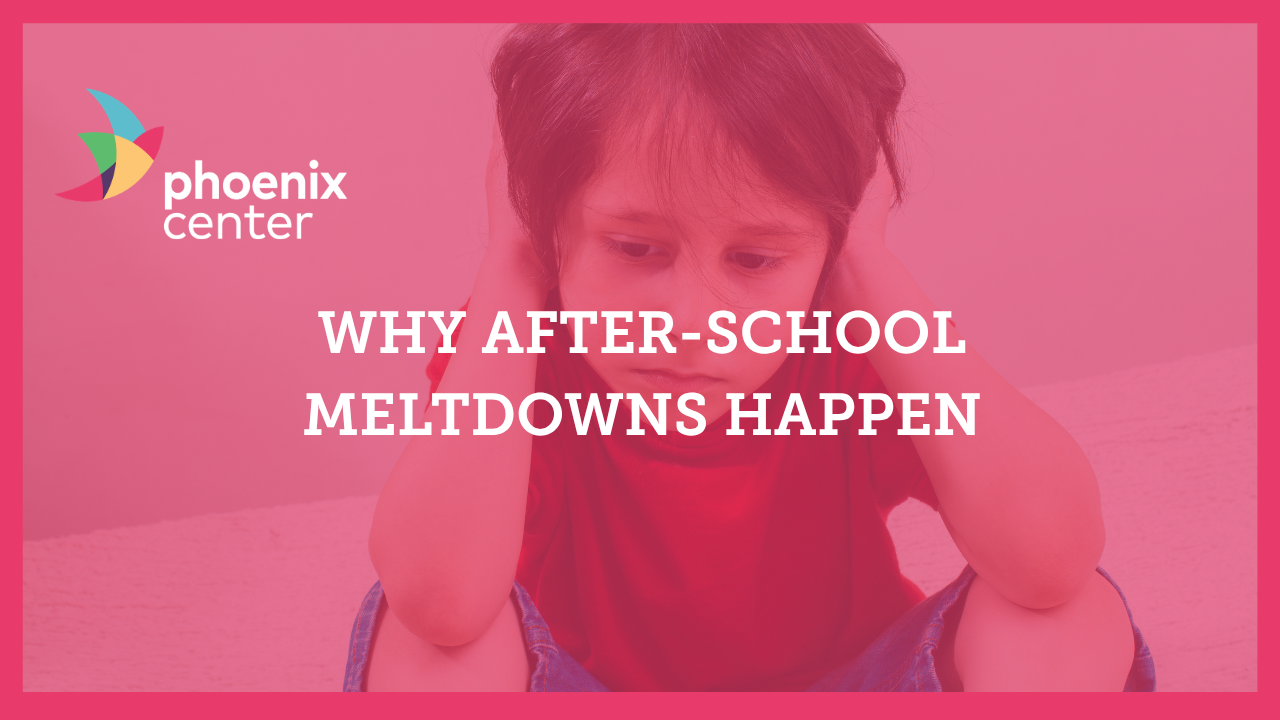
We asked our Phoenix Center therapists to explain why after-school meltdowns happen, when they're a normal part of growing up, and how parents can respond in ways that help children feel understood, supported, and emotionally safe.
HOME IS WHERE BIG FEELINGS FEEL SAFE

Many children spend the entire school day working incredibly hard to hold it together. They're paying attention, following directions, navigating friendships, managing disappointments, and meeting expectations, all while processing a constant stream of social, emotional, and academic demands. For some children, especially those who are neurodivergent, simply fitting in or masking their differences requires an enormous amount of energy. By the time the school day ends, their emotional reserves are often depleted.
When they finally walk through the front door, they're in the place where they feel safest. Home is where they no longer have to keep all of those emotions bottled up, and that's often when the tears, frustration, or meltdowns begin. As difficult as those moments can be, they're not necessarily a sign that you're doing something wrong. In many cases, they're a sign that your child trusts you enough to let their guard down and express the feelings they've been carrying all day.
THEIR NERVOUS SYSTEM IS FINALLY EXHALING

Throughout the school day, a child's nervous system is working hard behind the scenes. It's helping them pay attention, solve problems, manage emotions, navigate friendships, and respond to an ever-changing environment. For some children, especially those who have experienced trauma, are highly sensitive, or are neurodivergent, that constant effort can be even more demanding. If their nervous system spends much of the day on high alert or working overtime to manage stress, it can become physically and emotionally exhausting.
When children finally arrive home to a place where they feel safe, their nervous system is able to relax. The energy they've spent holding everything together has to go somewhere, and it may come out through tears, frustration, restlessness, excessive talking, or other behaviors that seem confusing in the moment. Rather than asking, "Why are they falling apart now?" it can be helpful to ask, "What has my child been carrying all day?" That simple shift in perspective can help parents respond with empathy while recognizing that big emotions are often a sign of an overwhelmed nervous system, not a child who is trying to be difficult.
WHEN ARE AFTER-SCHOOL MELTDOWNS NORMAL?

After-school meltdowns are more common than many parents realize. A long day of learning, navigating friendships, following routines, and managing emotions can leave children feeling physically and emotionally drained. Add in hunger, fatigue, sensory overload, or the stress of adjusting to a new school routine, and, understandably, some children reach the end of the day with very little left in their emotional tank.
For many children, these moments are a normal response to an overwhelming day, not a sign that something is wrong. In fact, if your child feels safe enough to express those big emotions at home, it often reflects the trust they have in you. The key is to look at the bigger picture. If the meltdowns gradually become less frequent as your child settles into the school routine and they're able to recover with support, that's often part of a healthy adjustment process. If they're becoming more intense, lasting longer, or beginning to interfere with your child's relationships, school experience, or daily life, it may be worth looking a little deeper.
CONCLUSION

The goal isn't to become an expert at recognizing every warning sign. It's simply to stay curious. When we respond to changes in a child's behavior with compassion instead of assumptions, we create opportunities for connection, understanding, and healing. Sometimes asking one simple question,
“I wonder what my child is trying to tell me?"
can be the first step toward getting the support they need.

WE’VE GOT YOU
Phoenix Center offers low- or no-cost mental healthcare for children, teens, and families.
If you're wondering whether your child could benefit from therapy, or if you're a teacher, physician, counselor, or community partner looking for guidance, we're here to help you navigate the next steps. Whether that means scheduling an appointment, visiting our free-of-cost walk-in clinic, or simply asking questions, our Phoenix Center team is happy to help you find the right fit for your child and family.
Every Family Deserves the Opportunity to Thrive.
Ready to connect?
Call Us: 830.637.7848
Email Us: Info@phoenixtx.org